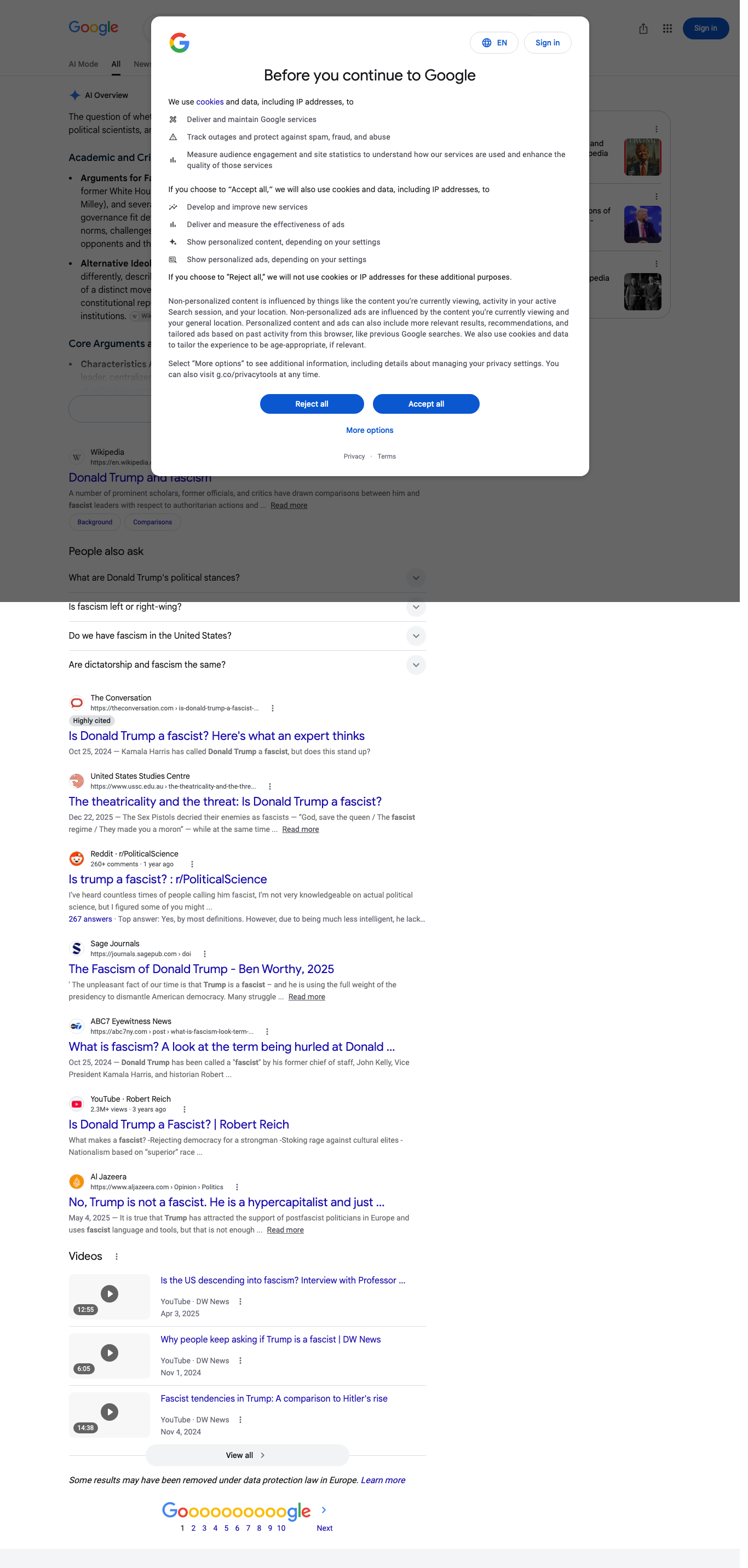
Google AI Overview
Google, ai_overview
- Answered, 7 Oct 2026, 16:56
- Answered, 7 Oct 2026, 21:42
Answered, checked 1 month ago Answered
Engaged with the question and gave a real answer. (classifier confidence 94%)
Read the response
The question of whether Donald Trump is a fascist is a subject of ongoing debate among historians, political scientists, and public figures, with no scholarly or political consensus. Wikipedia Academic and Critical Perspectives Arguments for Fascism or Authoritarianism: Critics, some former administration officials (such as former White House Chief of Staff John Kelly and former Chairman of the Joint Chiefs of Staff Mark Milley), and several scholars of fascism have argued that aspects of Donald Trump's rhetoric and governance fit definitions of fascism or authoritarianism. They point to his questioning of democratic norms, challenges to election results, praise for authoritarian leaders, rhetoric regarding political opponents and the media, and his involvement in the January 6 U.S. Capitol attack. Wikipedia Alternative Ideological Labels: Other political scientists and historians categorize his ideology differently, describing him as a right-wing populist, nationalist, conservative populist, or an exponent of a distinct movement termed Trumpism. They argue that he operates within the framework of a constitutional republic rather than seeking a total totalitarian state or the abolition of democratic institutions. Wikipedia +1 Core Arguments and Definitions Characteristics Associated with Fascism: Standard definitions of fascism include a dictatorial leader, centralized autocracy, militarism, the forcible suppression of opposition, and the subordination of individual interests to a perceived national rebirth. Critics argue that certain populist rallies, mass deportation proposals, and "law and order" rhetoric align with these patterns. Wikipedia +2 Characteristics Associated with Trumpism: Supporters and various analysts view his platform as centered on supply-side economics, deregulation, energy independence, nationalism, and skepticism of globalization and federal bureaucracy rather than classical 20th-century fascism. They reject the fascist label as partisan hyperbole meant to delegitimize his political movement. Wikipedia Wikipedia Donald Trump and fascism - Wikipedia Wikipedia Political positions of Donald Trump - Wikipedia Wikipedia Fascism - Wikipedia