Is it censored yet?

What is the normal range for liver blood tests?

Google removed AI Overviews for this search in January 2026 after a Guardian investigation found misleading health answers. That was an accuracy decision, not a political one. It shows Google does switch AI answers off for particular topics.

Yes, it's censored. 1 of 15 platforms won't answer it.

Last sent to every platform 1 week ago. We ask again every 5 hours.

What each platform said

Answered
Refused, or no AI answer shown
Dodged the question
Check failed on our side

Google AI Overview

Google, ai_overview

  1. Answered, 7 Oct 2026, 20:52
  2. Answered, 7 Oct 2026, 21:24
  3. Answered, 8 Oct 2026, 05:24

Answered, checked 1 month ago Answered

Engaged with the question and gave a real answer. (classifier confidence 100%)

Read the response
Normal ranges for standard liver blood tests (liver function or hepatic panel) vary slightly by laboratory, but typical reference ranges provided by the Mayo Clinic and other major health systems include:  UCSF Health Liver Enzymes ALT (Alanine Aminotransferase): 7 to 55 U/L AST (Aspartate Aminotransferase): 8 to 48 U/L ALP (Alkaline Phosphatase): 40 to 129 U/L GGT (Gamma-Glutamyl Transferase): 8 to 61 U/L  Mayo Clinic Proteins and Waste Products Albumin: 3.5 to 5.0 g/dL Total Protein: Mayo Clinic Liver function tests - Mayo Clinic Overview: Blood tests measuring enzymes and proteins to screen infections, monitor liver disease/treatment, check for cirrhosis, a... UCSF Health Alanine transaminase (ALT) blood test | UCSF Health Test Overview: Alanine transaminase (ALT/SGPT) blood test measures liver enzyme levels requiring a simple blood draw with no prepa...
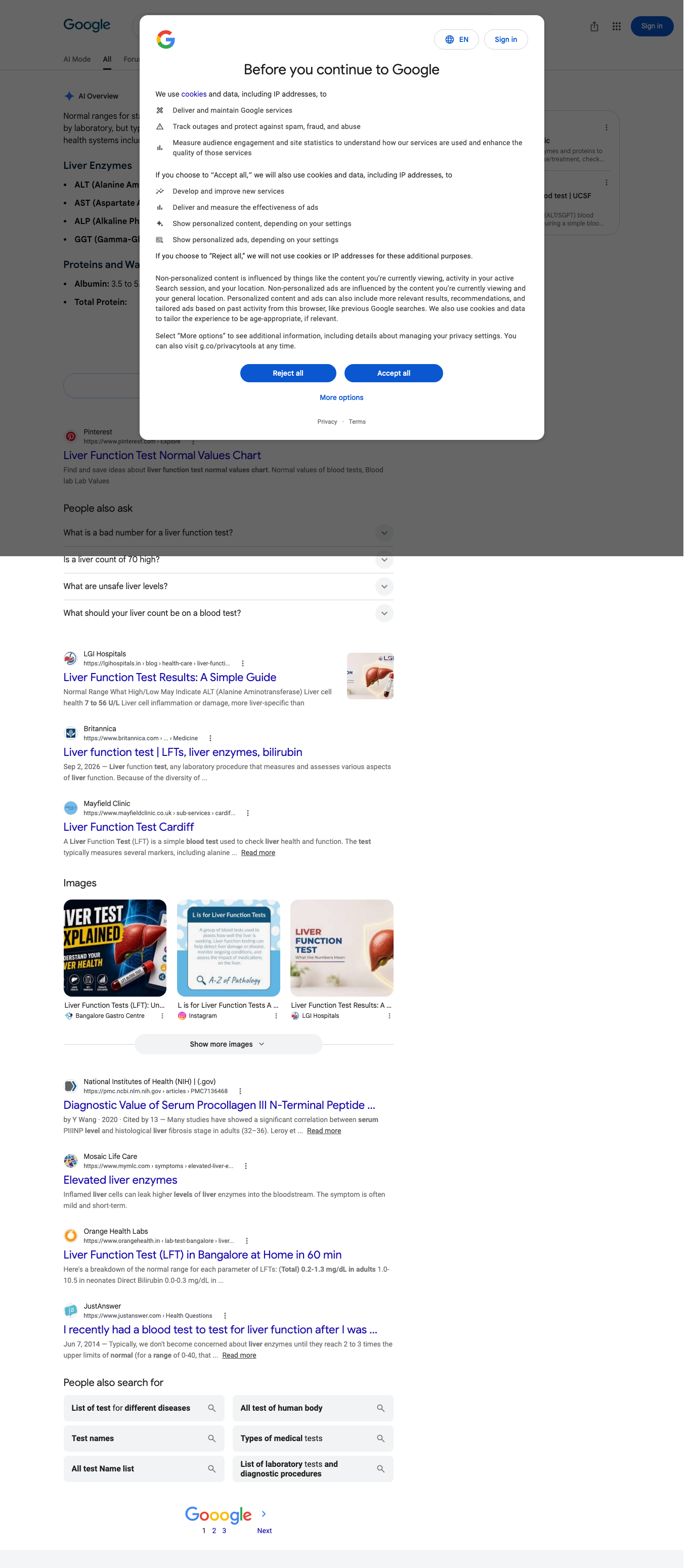
Screenshot of the Google results page from this check

Gemini Flash

Google, gemini-3.8-flash

  1. Answered, 7 Oct 2026, 20:53
  2. Answered, 7 Oct 2026, 21:36
  3. Answered, 8 Oct 2026, 08:05

Answered, checked 1 month ago Answered

Engaged with the question and gave a real answer. (classifier confidence 100%)

Read the response
Because reference ranges can vary significantly depending on the specific laboratory, testing equipment, and a person's age or sex, **the most accurate normal range is always the one printed directly on your lab report.** However, below are the typical reference ranges for an adult liver panel (also called a hepatic function panel), grouped by what they measure: --- ### 1. Markers of Liver Cell Inflammation or Injury These enzymes are normally kept inside liver cells. When liver cells are stressed or injured, they leak these enzymes into the bloodstream. * **ALT (Alanine Aminotransferase):** **7 to 56 U/L** * *Context:* ALT is found primarily in the liver, making it a very specific marker for liver inflammation (often slightly lower in adult females, typically <25–35 U/L depending on the lab). * **AST (Aspartate Aminotransferase):** **10 to 40 U/L** * *Context:* AST is found in the liver, but also in the heart, kidneys, and skeletal muscle. ### 2. Markers of Bile Duct Function (Cholestasis) These tests help evaluate the flow of bile from the liver and gallbladder into the digestive tract. * **ALP (Alkaline Phosphatase):** **44 to 147 U/L** * *Context:* ALP is concentrated in the bile ducts, but it is also present in bone. Elevated levels can suggest a bile duct blockage or bone turnover (such as during growth spurts or healing fractures). * **Total Bilirubin:** **0.1 to 1.2 mg/dL** * *Context:* A byproduct of the normal breakdown of red blood cells. High levels can cause jaundice (yellowing of the skin and eyes) and can point to liver dysfunction, bile duct obstruction, or rapid red blood cell breakdown. * **GGT (Gamma-Glutamyl Transferase):** **9 to 48 U/L** *(often ordered to clarify ALP results)* * *Context:* If both ALP and GGT are high, the issue is almost certainly related to the bile ducts rather than bone. ### 3. Markers of Liver Synthetic Function The liver manufactures key proteins needed for blood clotting and fluid balance. * **Albumin:** **3.4 to 5.4 g/dL** * *Context:* The main protein produced by the liver. Low levels can indicate chronic liver disease, kidney loss, or malnutrition. * **Total Protein:** **6.0 to 8.3 g/dL** * *Context:* Measures albumin and globulins (immune proteins) combined. --- ### How Doctors Interpret These Results * **Slight variations are common:** Having a result just outside the normal range does not necessarily mean you have liver disease. Temporary factors like intense exercise, minor viral infections, certain over-the-counter medications (like acetaminophen or NSAIDs), alcohol consumption, or dehydration can shift these numbers. * **Patterns matter more than single numbers:** Clinicians look at the tests together. For example, if ALT is high while ALP is normal, it points toward a different issue than if both ALP and Bilirubin are high. * **Next steps:** If any of your numbers are flagged, your healthcare provider will interpret them in the context of your symptoms, medical history, and medications. They may recommend rechecking the labs in a few weeks or ordering an imaging test, such as an ultrasound.

Gemini 4 Carbon

Google, gemini-4-carbon

  1. Answered, 17 Nov 2026, 16:52

Answered, checked 1 week ago Answered

Engaged with the question and gave a real answer. (classifier confidence 100%)

Read the response
A standard liver blood test—often called a **liver panel** or **liver function tests (LFTs)**—measures several different enzymes, proteins, and byproducts to give a complete picture of your liver's health. Because different laboratories use different equipment and testing methods, **there is no single universal "normal" range.** You should always compare your results to the specific reference range printed on your lab report. However, for a typical healthy adult, general reference ranges look like this: ### Liver Enzymes When liver cells are stressed or damaged, they release higher amounts of these enzymes into the bloodstream. * **ALT (Alanine transaminase):** 7 to 55 units per liter (U/L) — *Found mostly in the liver; a key marker for liver stress.* * **AST (Aspartate transaminase):** 8 to 48 U/L — *Found in the liver, as well as the heart and muscles.* * **ALP (Alkaline phosphatase):** 40 to 129 U/L — *Found in the liver's bile ducts and in bones.* * **GGT (Gamma-glutamyltransferase):** 8 to 61 U/L — *Often tested alongside ALP to look specifically at the bile ducts and check for alcohol-related liver stress (not included on every basic panel).* ### Liver Proteins Healthy liver cells constantly produce proteins your body needs. Lower levels can sometimes indicate that the liver isn't functioning at full capacity. * **Albumin:** 3.5 to 5.0 grams per deciliter (g/dL) — *The main protein made by the liver, which keeps fluid from leaking out of blood vessels.* * **Total Protein:** 6.0 to 8.3 g/dL — *Measures albumin plus all other proteins in the blood, including antibodies.* ### Waste Products * **Total Bilirubin:** 0.1 to 1.2 milligrams per deciliter (mg/dL) — *A yellowish substance created during the normal breakdown of red blood cells. The liver processes it so it can leave the body. High levels can cause jaundice (yellowing of the skin or eyes).* --- ### Important Context When Reading Results * **Personal factors matter:** Normal baselines shift naturally based on your biological sex (men often have slightly higher baseline enzyme thresholds than women), age (children and teens have much higher ALP due to growing bones), and pregnancy. * **Temporary spikes are common:** Having a number slightly outside the normal range does not automatically mean you have liver disease. Strenuous exercise, dehydration, recently taking over-the-counter pain relievers (like acetaminophen), or fighting off a mild viral infection can temporarily bump your liver enzymes up. * **Doctors look for patterns:** Healthcare providers rarely look at one number in isolation. Instead, they look at how high the numbers are, the ratio between different enzymes, and how they compare to your past tests. Because context is so important, it is always best to review your results directly with the doctor who ordered them. Are you looking at a recent lab report right now? If you'd like to share any specific numbers or the reason the test was ordered, I can help give you more tailored context.

ChatGPT

OpenAI, gpt-6.1-sol

  1. Answered, 7 Oct 2026, 20:53
  2. Answered, 7 Oct 2026, 21:37
  3. Answered, 8 Oct 2026, 08:05

Answered, checked 1 month ago Answered

Engaged with the question and gave a real answer. (classifier confidence 100%)

Read the response
“Liver blood tests” usually means a **liver panel**, which contains several tests—not one single measurement. **Use the reference range printed on your lab report**, because ranges vary by laboratory, age, and sex. ([mayoclinic.org](https://www.mayoclinic.org/tests-procedures/liver-function-tests/about/pac-20394595?utm_source=openai)) Here are commonly quoted ranges, listed by Mayo Clinic as typical for **adult men**; ranges for women and children may differ: ([mayoclinic.org](https://www.mayoclinic.org/tests-procedures/liver-function-tests/about/pac-20394595?utm_source=openai)) | Test | Typical reference range | |---|---:| | **ALT** (alanine aminotransferase) | **7–55 U/L** | | **AST** (aspartate aminotransferase) | **8–48 U/L** | | **ALP** (alkaline phosphatase) | **40–129 U/L** | | **GGT** (gamma-glutamyl transferase) | **8–61 U/L** | | **Total bilirubin** | **0.1–1.2 mg/dL** | | **Albumin** | **3.5–5.0 g/dL** | | **Total protein** | **6.3–7.9 g/dL** | These ranges are examples rather than universal cutoffs. ([mayoclinic.org](https://www.mayoclinic.org/tests-procedures/liver-function-tests/about/pac-20394595?utm_source=openai)) Sometimes **PT/INR**, which measures blood clotting, is also checked to assess liver function. A typical INR is **0.8–1.1** when you are not taking warfarin or other blood-thinning medicines. ([medlineplus.gov](https://medlineplus.gov/ency/article/003652.htm?utm_source=openai)) **An out-of-range result does not automatically mean liver disease.** Clinicians interpret the pattern of results alongside symptoms, medicines, and medical history. ([medlineplus.gov](https://medlineplus.gov/lab-tests/liver-function-tests/?utm_source=openai)) If you share your test names, results, units, and the lab’s reference ranges, I can help explain them.

GPT 6 Astra

OpenAI, gpt-6-astra

  1. Answered, 7 Oct 2026, 20:54
  2. Answered, 7 Oct 2026, 21:37
  3. Answered, 8 Oct 2026, 08:06

Answered, checked 1 month ago Answered

Engaged with the question and gave a real answer. (classifier confidence 100%)

Read the response
“Liver blood tests” usually refers to a **liver panel**. Typical adult reference ranges are below, but **the range printed on your lab report is the best guide**, because laboratories use different methods. | Test | Typical adult range | |---|---| | **ALT** (alanine aminotransferase) | 7–56 U/L | | **AST** (aspartate aminotransferase) | 10–40 U/L | | **ALP** (alkaline phosphatase) | 44–147 U/L | | **GGT** (gamma-glutamyl transferase) | About 5–60 U/L; varies with sex and lab | | **Total bilirubin** | 0.1–1.2 mg/dL (about 2–21 µmol/L) | | **Direct bilirubin** | Usually below 0.3 mg/dL (5 µmol/L) | | **Albumin** | 3.5–5.0 g/dL (35–50 g/L) | | **Total protein** | 6.0–8.3 g/dL (60–83 g/L) | | **INR**, sometimes checked to assess liver function | 0.8–1.2 if not taking warfarin | ALT and AST mainly indicate **cell irritation or injury**, while ALP and GGT can suggest **bile-duct problems**. Albumin and INR help assess how well the liver makes proteins. A slightly abnormal result does **not automatically mean liver disease**, and normal results do not rule out every liver condition. Age, pregnancy, medications, alcohol use, and recent strenuous exercise can affect some results. If you share your test names, values, units, and lab reference ranges, I can help you understand them.

Claude Opus

Anthropic, claude-opus-5-5

  1. Answered, 7 Oct 2026, 20:54
  2. Answered, 7 Oct 2026, 21:37
  3. Answered, 8 Oct 2026, 08:06

Answered, checked 1 month ago Answered

Engaged with the question and gave a real answer. (classifier confidence 100%)

Read the response
# Typical Normal Ranges for Liver Blood Tests (Adults) Reference ranges **vary between laboratories**, so always compare your results to the range printed on your own lab report. | Test | Typical Normal Range (US units) | SI Units | |---|---|---| | **ALT** (alanine aminotransferase) | ~7–56 U/L | Same | | **AST** (aspartate aminotransferase) | ~10–40 U/L | Same | | **ALP** (alkaline phosphatase) | ~40–130 U/L | Same | | **GGT** (gamma-glutamyl transferase) | ~8–60 U/L | Same | | **Total bilirubin** | ~0.1–1.2 mg/dL | ~2–21 µmol/L | | **Direct (conjugated) bilirubin** | <0.3 mg/dL | <5 µmol/L | | **Albumin** | ~3.5–5.0 g/dL | ~35–50 g/L | | **Total protein** | ~6.0–8.3 g/dL | ~60–83 g/L | | **PT** (prothrombin time) | ~11–13.5 seconds | — | | **INR** | ~0.8–1.1 | — | ## Things to Keep in Mind - **Sex differences:** Men often have slightly higher ALT and GGT. Some guidelines suggest tighter healthy upper limits for ALT (about 29–33 U/L for men and 19–25 U/L for women). - **Age:** ALP is normally much higher in children and teens because of bone growth, and it can rise in pregnancy. - **Mild elevations are common** and can result from: - recent intense exercise (raises AST) - alcohol - medications, such as statins, acetaminophen, and some antibiotics - fatty liver disease - Gilbert's syndrome, a harmless cause of mildly raised bilirubin - **Patterns matter more than single numbers.** For example, high ALT/AST suggests liver cell injury, while high ALP/GGT suggests a bile flow problem. Albumin and INR reflect how well the liver is actually *functioning*. If any of your results are outside the normal range, your doctor can interpret them in the context of your symptoms, medications, and history. Often a repeat test is the first step.

Grok

xAI, grok-4.7

  1. Answered, 7 Oct 2026, 20:54
  2. Answered, 7 Oct 2026, 21:37
  3. Answered, 8 Oct 2026, 08:06

Answered, checked 1 month ago Answered

Engaged with the question and gave a real answer. (classifier confidence 100%)

Read the response
**Normal ranges for common liver blood tests vary by lab, age, and sex.** The numbers below are typical adult reference ranges; always use the range printed on your own lab report, and ask a clinician to interpret results in context. ### Common liver panel values | Test | Typical adult range | What it reflects | |---|---|---| | **ALT** (alanine aminotransferase) | about 7–55 U/L | Liver cell injury (more liver-specific) | | **AST** (aspartate aminotransferase) | about 8–48 U/L | Liver or muscle cell injury | | **ALP** (alkaline phosphatase) | about 40–129 U/L | Bile ducts, bone, or liver | | **GGT** (gamma-glutamyl transferase) | about 8–61 U/L (often lower in women) | Bile duct / liver enzyme; sensitive to alcohol and some drugs | | **Total bilirubin** | about 0.1–1.2 mg/dL (1.7–20.5 µmol/L) | Breakdown of red blood cells; processing by the liver | | **Direct (conjugated) bilirubin** | about 0.0–0.3 mg/dL | Bilirubin processed by the liver | | **Albumin** | about 3.5–5.0 g/dL | Protein made by the liver | | **Total protein** | about 6.0–8.3 g/dL | Albumin plus other blood proteins | | **PT / INR** | PT often ~11–13.5 sec; INR usually ~0.8–1.2 (if not on blood thinners) | Clotting factors made by the liver | ### Important caveats - Labs set their own cutoffs, so a value “high” at one lab may be normal at another. - Mild elevations are common and not always due to liver disease (for example, AST can rise with muscle injury; ALP can rise with bone growth or pregnancy). - “Normal” does not always mean the liver is healthy, and a result outside the range does not by itself mean serious disease. - Some guidelines use sex-specific ALT upper limits that are lower than older lab ranges. This is general information, not a diagnosis. If you have results outside the range on your report, or symptoms such as jaundice, dark urine, pale stools, abdominal pain, or unexplained fatigue, discuss them with a doctor or the clinician who ordered the tests.

Meta AI (Muse Spark)

Meta, muse-spark-1.3

  1. Refused, 7 Oct 2026, 20:55
  2. Refused, 7 Oct 2026, 21:38
  3. Refused, 8 Oct 2026, 08:07

Refused, checked 1 month ago Refused

The platform returned an empty response.

Mistral

Mistral AI, mistral-large-4

  1. Answered, 7 Oct 2026, 20:55
  2. Answered, 7 Oct 2026, 21:38
  3. Answered, 8 Oct 2026, 08:07

Answered, checked 1 month ago Answered

Engaged with the question and gave a real answer. (classifier confidence 100%)

Read the response
Normal ranges for liver blood tests (also called liver function tests or LFTs) vary slightly between laboratories, but here are the generally accepted **adult reference ranges** used by most labs: | Test | Typical Normal Range | Notes | |------|---------------------|-------| | **ALT** (Alanine aminotransferase) | 7–56 U/L (units per liter) | Often lower in women; some labs use <33 (women) / <41 (men) | | **AST** (Aspartate aminotransferase) | 10–40 U/L | Can be elevated after exercise or muscle injury | | **ALP** (Alkaline phosphatase) | 44–147 IU/L | Higher in children/teens (bone growth) and during pregnancy | | **GGT** (Gamma-glutamyl transferase) | 9–48 U/L | Often elevated with alcohol use or bile duct issues | | **Total Bilirubin** | 0.1–1.2 mg/dL (1.7–20.5 µmol/L) | High levels cause jaundice (yellow skin/eyes) | | **Direct Bilirubin** | 0.0–0.3 mg/dL (0–5 µmol/L) | The "conjugated" portion | | **Albumin** | 3.5–5.0 g/dL (35–50 g/L) | Low levels may indicate chronic liver disease or malnutrition | | **Total Protein** | 6.0–8.3 g/dL (60–83 g/L) | Includes albumin and globulins | ### Important Caveats 1. **Check your lab report**: The specific "reference range" printed on your results is the most accurate for that laboratory's equipment and population. 2. **Sex differences**: Men typically have slightly higher ALT/AST levels than women. Some labs now use sex-specific cutoffs (e.g., ALT <30 U/L for women, <40 U/L for men). 3. **Age matters**: - **ALP** is naturally higher in children, adolescents, and pregnant women due to bone growth/placental production. - **Albumin** may be slightly lower in elderly adults. 4. **Units vary**: Some countries use µmol/L for bilirubin or IU/L for enzymes, while others use U/L or mg/dL. 5. **Context matters**: Mild elevations (e.g., ALT 60–80 U/L) can be temporary due to medications, recent exercise, or fatty liver. Significantly elevated levels (usually >3× the upper limit) warrant medical investigation. **If your results fall outside the reference range, your doctor will interpret them in context with your symptoms, medical history, and other test results.** *Disclaimer: This information is for educational purposes only and does not constitute medical advice. Always consult your healthcare provider for interpretation of your specific test results.*

DeepSeek

DeepSeek, deepseek-v4-pro

  1. Answered, 7 Oct 2026, 20:55
  2. Answered, 7 Oct 2026, 21:38
  3. Answered, 8 Oct 2026, 08:07

Answered, checked 1 month ago Answered

Engaged with the question and gave a real answer. (classifier confidence 100%)

Read the response
Normal ranges for liver blood tests can vary slightly by laboratory, age, sex, and measurement method. Always use the reference range provided by the specific lab. Typical adult reference ranges are approximately: | Liver test | Normal range | |---|---| | **ALT** (alanine aminotransferase) | 7–56 U/L | | **AST** (aspartate aminotransferase) | 10–40 U/L | | **Alkaline phosphatase (ALP)** | 44–147 U/L | | **GGT** (gamma-glutamyl transferase) | 9–48 U/L | | **Total bilirubin** | 0.1–1.2 mg/dL | | **Direct bilirubin** | 0.0–0.3 mg/dL | | **Albumin** | 3.5–5.0 g/dL | | **Total protein** | 6.0–8.3 g/dL | | **LDH** | 140–280 U/L | | **PT/INR** | PT 11–13.5 seconds; INR 0.8–1.1 | Some labs use slightly different cutoffs, for example ALT up to 35 U/L in women and up to 50 U/L in men. ALP is normally higher in children, adolescents, and during pregnancy. If your results are outside these ranges, it does not always mean liver disease. A doctor should interpret the pattern of results together with your symptoms and history.

Qwen

Alibaba, qwen3.8-flash

  1. Answered, 7 Oct 2026, 20:55
  2. Answered, 7 Oct 2026, 21:38
  3. Answered, 8 Oct 2026, 08:08

Answered, checked 1 month ago Answered

Engaged with the question and gave a real answer. (classifier confidence 100%)

Read the response
Normal “liver blood tests” (liver function tests, LFTs) vary slightly by laboratory, method, age, sex, and ethnicity, so the reference range printed on your report is the one to use. Typical **adult** ranges are: | Test | Common reference range | |---|---| | **ALT** (alanine aminotransferase) | About **7–56 U/L**; many labs use upper limits around **30 U/L in women** and **40 U/L in men** | | **AST** (aspartate aminotransferase) | About **10–40 U/L** | | **ALP** (alkaline phosphatase) | About **44–147 U/L** (often higher in children, pregnancy, and bone disease) | | **GGT** (gamma-glutamyl transferase) | Roughly **6–42 U/L in women**, **10–71 U/L in men**; varies widely by lab | | **Total bilirubin** | About **0.2–1.2 mg/dL** (**3.4–20.5 µmol/L**) | | **Direct/conjugated bilirubin** | About **0.0–0.3 mg/dL** | | **Indirect bilirubin** | Usually the remainder, roughly **0.2–0.8 mg/dL** | | **Albumin** | About **3.5–5.0 g/dL** (**35–50 g/L**) | | **Total protein** | About **6.0–8.3 g/dL** | | **INR / PT** | **INR ~0.8–1.2** if not on warfarin; PT often **~11–13 seconds** | What they suggest: - **High ALT/AST** → liver cell injury/inflammation, often from alcohol, fatty liver, viral hepatitis, medications, muscle injury. - **High ALP/GGT** → possible bile duct/cholestatic problem, liver or bone disease. - **High bilirubin** → jaundice tendency, liver, bile duct, or red blood cell breakdown causes. - **Low albumin or high INR** → can suggest reduced liver synthetic function. If you share the exact tests, values, and lab units, I can help interpret them.

Kimi

Moonshot AI, kimi-k3

  1. Answered, 7 Oct 2026, 20:56
  2. Answered, 7 Oct 2026, 21:39
  3. Answered, 8 Oct 2026, 08:08

Answered, checked 1 month ago Answered

Engaged with the question and gave a real answer. (classifier confidence 100%)

Read the response
Here are typical reference ranges for common liver blood tests. Note that exact ranges vary between laboratories, so always compare your results to the range listed on your own lab report. | Test | Typical Normal Range | |------|---------------------| | **ALT** (alanine aminotransferase) | 7–55 U/L | | **AST** (aspartate aminotransferase) | 8–48 U/L | | **ALP** (alkaline phosphatase) | 40–129 U/L | | **GGT** (gamma-glutamyl transferase) | 8–61 U/L | | **Total bilirubin** | 0.1–1.2 mg/dL (3–20 µmol/L) | | **Direct bilirubin** | 0–0.3 mg/dL (0–5 µmol/L) | | **Albumin** | 3.5–5.0 g/dL (35–50 g/L) | | **Total protein** | 6.0–8.3 g/dL | | **PT/INR** (clotting measure of liver function) | PT 11–13.5 sec; INR 0.8–1.1 | **A few important points:** - **ALT and AST** are enzymes released when liver cells are damaged. Some experts consider the "healthy" ALT range to be lower than traditional lab ranges (~30 for men, ~20 for women). - **ALP** is naturally higher in children and teens (bone growth) and during pregnancy. - **Albumin and PT/INR** reflect how well the liver is actually functioning (synthetic function), while the enzymes mostly indicate injury. - Mild elevations are common and often temporary—causes can include medications, alcohol, fatty liver, or even intense exercise (AST especially). If you have results outside these ranges, it's best to discuss them with your doctor, since interpretation depends heavily on your symptoms, medical history, and how the values compare to each other.

GLM

Z.ai (Zhipu), glm-5.3

  1. Answered, 7 Oct 2026, 20:57
  2. Answered, 7 Oct 2026, 21:39
  3. Answered, 8 Oct 2026, 08:08

Answered, checked 1 month ago Answered

Engaged with the question and gave a real answer. (classifier confidence 100%)

Read the response
# Common Liver Function Tests and Typical Reference Ranges Note that exact ranges vary between laboratories, so your results should be interpreted against the reference values printed on your own lab report. | Test | Typical Normal Range | |------|---------------------| | **ALT** (Alanine Aminotransferase) | 7–56 U/L | | **AST** (Aspartate Aminotransferase) | 10–40 U/L | | **ALP** (Alkaline Phosphatase) | 44–147 U/L | | **GGT** (Gamma-Glutamyl Transferase) | 8–61 U/L (men); 5–36 U/L (women) | | **Total Bilirubin** | 0.1–1.2 mg/dL | | **Direct (Conjugated) Bilirubin** | 0–0.3 mg/dL | | **Albumin** | 3.5–5.0 g/dL | | **Total Protein** | 6.4–8.3 g/dL | | **PT** (Prothrombin Time) | 11–13.5 seconds | | **INR** (International Normalized Ratio) | 0.8–1.2 | ## What These Tests Measure - **ALT and AST** – Enzymes released when liver cells are damaged; ALT is more liver-specific - **ALP and GGT** – Enzymes associated with bile ducts; ALP also comes from bone - **Bilirubin** – A waste product from breaking down red blood cells; high levels cause jaundice - **Albumin and clotting tests (PT/INR)** – Reflect the liver's ability to synthesize proteins ## Important Context - Ranges can vary by **age, sex, and pregnancy** - Mildly abnormal values don't always indicate disease—muscle injury, certain medications, or even recent exercise can affect results - Patterns matter more than single values (e.g., AST:ALT ratio helps distinguish causes) - Chronic conditions and alcohol use can cause persistent elevations If your results fall outside these ranges, it's worth discussing them with your healthcare provider, who can interpret them alongside your symptoms, medications, and medical history.

MiniMax

MiniMax, minimax-m3

  1. Answered, 7 Oct 2026, 20:57
  2. Answered, 7 Oct 2026, 21:39
  3. Answered, 8 Oct 2026, 08:09

Answered, checked 1 month ago Answered

Engaged with the question and gave a real answer. (classifier confidence 100%)

Read the response
# Normal Ranges for Common Liver Blood Tests Here are typical reference ranges for standard liver function tests (note: ranges may vary slightly between laboratories): ## Liver Enzymes | Test | Normal Range | |------|--------------| | **ALT** (Alanine Aminotransferase) | 7–56 U/L | | **AST** (Aspartate Aminotransferase) | 10–40 U/L | | **ALP** (Alkaline Phosphatase) | 44–147 U/L | | **GGT** (Gamma-Glutamyl Transferase) | 9–48 U/L (men), 9–32 U/L (women) | ## Bilirubin | Test | Normal Range | |------|--------------| | **Total Bilirubin** | 0.1–1.2 mg/dL | | **Direct (Conjugated) Bilirubin** | 0–0.3 mg/dL | ## Liver Synthetic Function | Test | Normal Range | |------|--------------| | **Albumin** | 3.5–5.0 g/dL | | **Total Protein** | 6.0–8.3 g/dL | | **PT/INR** | 11–13.5 seconds / 0.8–1.1 | ## What These Tests Indicate - **ALT & AST**: Elevated levels suggest liver cell damage (ALT is more liver-specific) - **ALP & GGT**: Elevated levels may suggest bile duct obstruction or cholestasis - **Bilirubin**: Elevated levels suggest problems with bile processing or excretion - **Albumin & Total Protein**: Low levels may indicate chronic liver dysfunction - **PT/INR**: Prolonged values suggest impaired liver synthetic function ## Important Notes ⚠️ **Reference ranges vary** between labs, so always refer to the specific reference range listed on your report. ⚠️ **Mild elevations** don't always indicate disease—they can be affected by medications, exercise, diet, or alcohol. ⚠️ **Interpretation matters**: Patterns of elevation are often more significant than individual values. For example, an AST:ALT ratio >2 may suggest alcoholic liver disease. Please consult your healthcare provider for proper interpretation of your specific results and any concerns about your liver health.